College of Nursing Research
Research in the University of Tennessee Health Science Center’s College of Nursing
aligns with the overall UT Health Science Center Research Mission and Vision
Mission: To cultivate and support discovery, innovations, commercialization, and economic
growth within the University of Tennessee Health Science Center and the State of Tennessee
with the dedication to improve the health of Tennesseans, the nation, and the global
community.
Vision: To become a world-class, interdisciplinary, and research-intensive health science
center.
The UT Health Sciences College of Nursing promotes nursing-led, collaborative, and
interdisciplinary research focused on measuring and improving biomedical and behavioral
outcomes for patients. Throughout our research, we seek to foster collaborations with
clinically and educationally focused faculty in nursing and our clinical colleagues
from other disciplines. This collaboration aids in implementing evidence-based research
in the clinical setting. Our nationally and internationally recognized faculty have
received funding through federal agencies, foundations, professional organizations,
and industry sponsors.
Nurse scientists work in the overlap between innovation and community context and
contribute their unique lens to this research. Because of this nursing lens, the community
context (i.e., our Mid-South region) drives many of the health conditions our faculty
members study while we work with the community – not on the community – to find solutions that improve human health. The needs of our community
in turn promote innovative solutions for how we intervene and collaborate with other
disciplines to improve the health and wellness of the people we serve locally, in
our state, in our nation, and globally.
Faculty research interests fall into the following four categories: prevention, differences
in population health outcomes, health systems, and patient biomedical and behavioral
outcomes. The college’s Areas of Excellence include Stroke, Sickle Cell Disease, and
Rural and Underserved Health Care.
Areas of Excellence
Funding Highlights
$12 million to establish a Tennessee Rural Health Care Center of Excellence at UT Health Science
Center
$4 million for Midwifery education
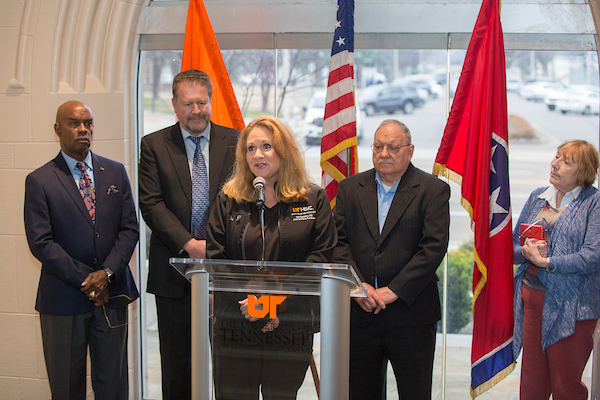
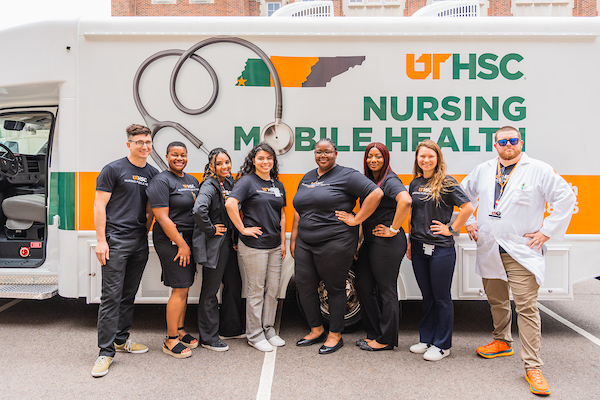
$3.98 million for to increase health care access in rural counties with a mobile health unit.
$2.6 million to support Doctor of Nursing Practice students
$3.6 million for a second rural mobile health unit
$1.5 million to increase simulation in education
$1.5 million to support nursing graduates in their transition to work in rural or underserved hospitals
$500,000 to send vans to 3 rural regions for health care education
$364,000 grant to provide specialized sickle cell education for rural providers
The Research Faculty
Dr. Anne Alexandrov
Dr. Alexandrov is the leading international nursing expert in acute stroke. Her research
has two primary areas of focus: testing interventions to optimize blood flow and disability
outcomes in patients with acute stroke and exploring innovative methods to optimize the
health systems where stroke patients are managed. She has received many awards, including
being inducted into the International Nurse Researcher Hall of Fame by Sigma Theta
Tau International Honor Society of Nursing in 2026, and receiving the Outstanding
Nurse Scientist and Mentor Award from the Council on the Advancement of Nursing Science of the American
Academy of Nursing in 2024. She was selected to receive the Research Article of the Year
Award in 2026 by the Council on Cardiovascular and Stroke Nursing for her article
on the ZODIAC trial in JAMA Neurology.
Dr. Janeane N. Anderson
Dr. Anderson’s research targets the relationship between patient-clinician communication
practices and clinical and quality of life outcomes among Black women with chronic
health conditions, specifically breast cancer and vulvovaginal and pelvic pain. She
is the Co-PI of a three-year, $1.58 million industry-sponsored grant to investigate
multilevel barriers to healthcare access and utilization among Black women with advanced-stage
breast cancer (Stage IIIB, IIIC, and Stage IV) and those with elevated risk for breast
disease in the U.S. Mid-South region. She is also a co-investigator of a study to
explore patient-clinician communication and service receipt challenges among Black
women diagnosed with vulvar lichen sclerosis.
Dr. Lisa Beasley
Dr. Lisa Beasley conducts research that advances healthcare access for rural and underserved
populations through forensic nursing, community-engaged partnerships, and healthcare
workforce development. Her work integrates education, practice, and implementation
science to expand access to high-quality care, strengthen the nursing workforce, and
improve outcomes for individuals and communities across Tennessee and beyond.
Dr. Xueyuan Cao
Dr. Cao's methodological research focuses on developing and applying statistical methods
to integrate multi-omics data in cancer research. In collaboration with investigators
at the University of Florida and St. Jude Children's Research Hospital, he studies
pharmacogenomics to identify molecular determinants of treatment response and improve
outcomes for children with acute myeloid leukemia (AML). In addition, he provides
statistical collaboration and methodological support to investigators across the College
of Nursing.
Dr. Ann Cashion
Dr. Cashion has been exploring genetic markers’ to predict clinical outcomes for more
than 25 years. Her previously funded research and clinical interests target genetic/genomic
and environmental components associated with outcomes of organ transplantation. She
has served as Scientific Director of NINR’s Division of Intramural Research and acting
director of NINR/NIH. Dr. Cashion is a well-known scientist and leader with numerous
awards and recognitions. She has more than 50 publications and serves as a scientific
reviewer for multiple journals and professional organizations.
Dr. Derek Dangerfield
Dr. Dangerfield is a prevention scientist whose research is grounded in Life Course
Theory and focuses on sexual epidemiology among racial and sexual minority populations.
His work advances understanding of HIV/STI prevention and care in the United States
while examining how social, structural, and developmental factors shape health across
the lifespan.
Dr. Sara Day
Dr. Day's research has advanced pediatric nursing worldwide through innovative programs
for sickle cell disease and pediatric oncology. Her evidence-based work has improved
patient outcomes, informed international nursing standards implemented in 31 countries,
and generated influential scholarship, competitive grant funding, and prestigious
honors recognizing her sustained global impact on nursing practice. She was inducted
into the International Nurse Researcher Hall of Fame.
Dr. Diana Dedmon
Dr. Dedmon’s research centers on nurse-led healthcare delivery models that improve
access to primary care and address health disparities in rural and underserved populations.
Her scholarship focuses on evaluating innovative models of community-based care, including
mobile health units, while advancing experiential learning opportunities that prepare
nursing students to practice in rural settings. Her work bridges clinical practice,
education, and evidence-based practice innovation to improve health outcomes and strengthen
the rural healthcare workforce.
Dr. Marie Gill
Since 2014, Dr. Gill’s research has evolved to advance nursing science by designing
approaches to strengthen nursing theory education across BSN and DNP curricula. Building
on her earlier work in health literacy and development of an adverse childhood experiences
curricular integration model, Dr. Gill’s current studies focus on how faculty value
theory and their readiness to teach nursing theory; and the analysis of historical
documents and artifacts regarding Margaret Newman’s Nursing Theory Think Tanks during
the nursing Grand Theory movement. Dr. Gill will extend her research to help prepare
faculty to teach nursing theory and to test high-impact teaching strategies for nursing
theory education with students across undergraduate, graduate, and doctoral nursing
programs.
Dr. Tyra Girdwood
Dr. Girdwood is a social scientist and health services researcher with a clinical
nursing background. Her research focuses on improving transitional care management,
care coordination services, patient navigation, and health outcomes for at-risk populations.
She is particularly interested in improving services and policies regarding the transition
from pediatric to adult healthcare for adolescents and young adults with chronic conditions.
She has experience conducting quantitative, qualitative, and mixed methods studies,
primary and secondary analyses, as well as utilizing medical record data, national
datasets, and other data sources.
Dr. Carolyn Graff
Dr. Graff's research focuses on the influence of prenatal and early childhood environments
on health and developmental trajectories across childhood. She is the director of
the PhD in Nursing Science program and has experience in qualitative, quantitative,
and mixed methods research methodology. She is the co-principal investigator for the
Shelby County Relative Caregiver program.
Dr. Alisa HaushalterDr. Haushalter's
research and scholarly activities are grounded in public/population health nursing
shaped by extensive practice and leadership experience within local governmental public
health, a large multi-state pediatric health system, and academia. She focuses on
the development, implementation, and evaluation of practice relevant strategies that
strengthen community capacity to improve health for all. She has developed a complementary
line of nursing history scholarship that uses archival research, oral history, and
narrative inquiry to illuminate the role of nurses and, particularly, public health
nurses throughout history.
Dr. Wendy LIkes
As a certified family nurse practitioner, Dr. Likes has focused on cancer and pre-invasive
gynecologic conditions in her early research. She also founded the Center for HPV
and Dysplasia at Regional One Health. In recent years, her research focus has been
on rural health and workforce development. She is the principal investigator for the
Tennessee Rural Health Care Center of Excellence.
Dr. Shannon Rose
Dr. Rose’s research program utilizes immunometabolism to investigate how immune cell
bioenergetics drive systemic inflammation in childhood obesity and autism spectrum
disorder (ASD). Her studies in obesity aim to identify early immunometabolic shifts
occurring prior to the onset of glucose intolerance in order to find novel therapeutic
targets that halt metabolic decline. In ASD, she focuses on mapping the relationships
between immune-metabolic biomarkers and clinical phenotypes to identify distinct subtypes
of the disorder.
Dr. Andrea Sebastian
Dr. Sebastian's research focuses on improving the identification, evaluation, and
outcomes of patients experiencing violence, abuse, and trauma through advancements
in forensic nursing education, clinical practice, and interdisciplinary collaboration.
Her scholarship emphasizes the development of innovative educational strategies, simulation-based
learning, and evidence-based approaches to strengthen the forensic nursing workforce,
expand access to high-quality medical forensic care in rural and underserved communities,
and improve the recognition and management of child maltreatment and other forms of
interpersonal violence.
Dr. Nina Sublette
Dr. Sublette is a family nurse practitioner at the University of Tennessee-Regional
One Physicians Group’s Maternal-Fetal Medicine clinic, providing comprehensive care
for pregnant women living with HIV. Dr. Sublette serves as a research consultant with
St. Jude Children's Research Hospital's Department of Infectious Diseases and a co-investigator
for perinatal and neonatal clinical trials through the International Maternal Pediatric
Adolescent AIDS Clinical Trials Network. Her research interests include HIV prevention,
depression, anxiety, antiretroviral adherence and pharmacokinetics, and sexual assault.